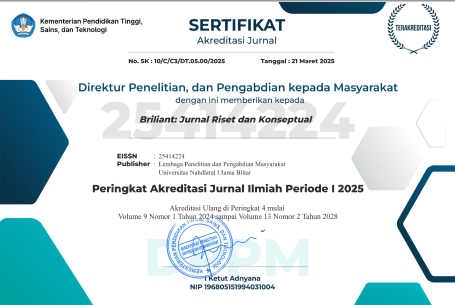
Gender Equality in Forest Bioeconomy Based on Nahdlatul Ulama's Ahlussunnah wal Jama'ah (Aswaja) Values: A Conceptual Framework for Strengthening Indonesia's Non-Military Defense
DOI:
https://doi.org/10.28926/briliant.v11i3.2502Keywords:
Aswaja, forest bioeconomy, gender equality, non-military defense, social capitalAbstract
The growing complexity of non-military threats requires Indonesia to strengthen national resilience through approaches that extend beyond conventional defense institutions. In this context, forest bioeconomy, gender equality, and community-based social values have strategic relevance for enhancing non-military defense. This study aims to develop a conceptual framework integrating gender equality in forest bioeconomy based on the values of Ahlussunnah wal Jama'ah (Aswaja) promoted by Nahdlatul Ulama as a strategy to strengthen Indonesia's non-military defense. The research employed a qualitative approach using the Integrative Literature Review (ILR) method by synthesizing scientific publications, institutional theories, social capital literature, and relevant national policy documents. The findings indicate that Aswaja values function as informal institutions that provide social legitimacy for gender equality, while gender-inclusive forest bioeconomy enhances governance quality, women's participation, social capital, collective action, and community resilience. These interrelated processes contribute to strengthening national capacity in addressing non-military threats through improved food, energy, water, environmental, economic, and social resilience. The main contribution of this study is the development of an interdisciplinary conceptual framework connecting institutional theory, gender studies, forest bioeconomy, social capital, and non-military defense within the Indonesian context. This framework provides a theoretical foundation for integrating forestry development, gender mainstreaming, and national defense policies toward Indonesia Emas 2045.
References
Azizah, L. (2026). Women forest defenders and inclusive institutionalism: Assessing gender capacity and policy instruments in community-based forestry. Jurnal Bisnis Kehutanan dan Lingkungan, 3(2), 92–107. https://doi.org/10.61511/jbkl.v3i2.2026.2560
Baublyte, G., Korhonen, J., D’Amato, D., & Toppinen, A. (2019). “Being one of the boys”: perspectives from female forest industry leaders on gender diversity and the future of Nordic forest-based bioeconomy. Scandinavian Journal of Forest Research, 34(6), 521–528. https://doi.org/10.1080/02827581.2019.1598484
Bitzer, V., Moździerz, M., Kuijpers, R., Schouten, G., & Juju, D. B. (2024). Gender and forest resources in low- and middle-income countries: A systematic literature review. Forest Policy and Economics, 163, 103226. https://doi.org/10.1016/j.forpol.2024.103226
Bocci, C., & Mishra, K. (2021). Forest power: The impact of community forest management on female empowerment. Ecological Economics, 187, Article 107105. https://doi.org/10.1016/j.ecolecon.2021.107105
Cameron, L. (2023). Gender equality and development: Indonesia in a global context. Bulletin of Indonesian Economic Studies, 59(2), 179–207. https://doi.org/10.1080/00074918.2023.2229476
Eko Hartono, E., & Khalwani, K. M. (2022). Inovasi dan Tantangan Pengarusutamaan Gender di Kementerian Lingkungan Hidup dan Kehutanan Republik Indonesia. Jurnal Perempuan, 27(1), 1–14. https://indonesianfeministjournal.org/index.php/IFJ/article/view/656
Elias, M., Zaremba, H., Tavenner, K., Ragasa, C., Paez Valencia, A. M., Choudhury, A., & de Haan, N. (2024). Towards gender equality in forestry, livestock, fisheries and aquaculture. Global Food Security, 41, 100761. https://doi.org/10.1016/j.gfs.2024.100761
Firmansyah, R. (2024). Islam and Women's Emancipation: Initiating Progressive Steps Towards Muslim Gender Equality in Indonesia. Journal of Feminism and Gender Studies. https://doi.org/10.19184/jfgs.v4i2.47420
Hartono, E. E., & Khalwani, K. M. (2022). The innovations and challenges of gender mainstreaming in Indonesian Ministry of Environment and Forestry. Jurnal Perempuan, 27(1), 1–13. https://doi.org/10.34309/jp.v27i1.656
Hayati, Muktasam, Sayuti, R. H., & Valentino, N. (2022). Perspective in community forest management in Central Lombok Regency. IOP Conference Series: Earth and Environmental Science, 1107, 012117. https://doi.org/10.1088/1755-1315/1107/1/012117
Indonesia. Law Number 59 of 2024 concerning the National Long-Term Development Plan (RPJPN) 2025–2045. State Gazette of the Republic of Indonesia of 2024 No. 194. Jakarta, 2024. https://peraturan.bpk.go.id/Details/299728/uu-no-59-tahun-2024
Indonesia. Presidential Regulation Number 12 of 2025 concerning the National Medium-Term Development Plan (RPJMN) 2025–2029. State Gazette of the Republic of Indonesia of 2025 No. 19. Jakarta, 2025. https://peraturan.bpk.go.id/Details/314638/perpres-no-12-tahun-2025
Irhamsyah, F., & Anshor, M. U. (2023). Contribution of the Nahdlatul Ulama (NU) social movement to gender Issue and empowerment of women in Indonesia (1938-2022). The International Journal of Pegon : Islam Nusantara civilization. https://doi.org/10.51925/inc.v11i03.91
Isnaini, R. L., Hanum, F., & Prasojo, L. D. (2021). Quality management development through gender equality based leadership in Nahdlatul Ulama universities. The Qualitative Report, 26(11), 3374–3391. https://doi.org/10.46743/2160-3715/2021.4877
Jagati, P. (2024). Issues and challenges with empowerment of tribal women in India: A forest-based study. Asia Minor Studies, 12(2), 213–220. https://doi.org/10.17067/asm.1445005
Lidestav, G., Johansson, M., Huff, E.S. (2019). Gender Perspectives on Forest Services in the Rise of a Bioeconomy Discourse. In: Hujala, T., Toppinen, A., J. Butler, B. (eds) Services in Family Forestry. World Forests, vol 24. Springer, Cham. https://doi.org/10.1007/978-3-030-28999-7_15
Maulana, A. (2024). Santri’s multi-track diplomacy in promoting the Islam Nusantara identity to global. Journal of Islamic Civilization, 5(2), 177–191. https://doi.org/10.33086/jic.v5i2.5334
Ministry of Environment and Forestry Republic of Indonesia. (2024). The State of Indonesia`s Forest 2024 Toward Ecosystem In Indonesia (Vol. 4). Ministry of Environment and Forestry Republic of Indonesia. https://ppid.menlhk.go.id/berita/infografis/7807/the-state-of-indonesias-forests-soifo-2024
Ministry of Forestry of the Republic of Indonesia. (2025). Regulation of the Minister of Forestry Number 18 of 2025 concerning the Strategic Plan of the Ministry of Forestry for the Years 2025–2029. State Gazette of the Republic of Indonesia Year 2025 Number 737. https://jdih.kehutanan.go.id/new2/home/portfolioDetails3/PERMENHUT_18_2025.pdf/18/2025/5/1302
Mutiullah, M. Y. N. (2024). Defending women beyond feminism: Gender perspectives in Indonesia. Jurnal Theologia, 35(1), 87–108. https://doi.org/10.21580/teo.2024.35.1.18861
North, D. C. (1990). Institutions, Institutional Change and Economic Performance. Cambridge University Press. https://doi.org/10.1017/CBO9780511808678
Nugraha, A. T., Fikriyah, Zahara, S., Suhartini, I., Zahid, U., & Hlahla, J. (2024). The role of social capital on community resilience in rural areas: A case study in Ponggok Village, Indonesia. Journal of Regional and Rural Studies, 2(1), 1–14. https://doi.org/10.21776/rrs.v2i1.27
Ostrom, E., & Ahn, T. K. (2008). The meaning of social capital and its link to collective action. In G. T. Svendsen & G. L. Svendsen (Eds.), Handbook on Social Capital. Edward Elgar. https://ssrn.com/abstract=1936058
President of the Republic of Indonesia. (2025). Peraturan Presiden Nomor 111 Tahun 2025 tentang Kebijakan Umum Pertahanan Negara Tahun 2025-2029 [Presidential Regulation Number 111 of 2025 concerning the General Policy of State Defense 2025-2029]. https://jdih.bpkp.go.id/pencarian/5871/detail
Rahayu, L., Sihombing, D. N., & Santoso, P. (2024). Indonesia’s non-military threats dynamics: A philosophical perspective. Jurnal Pertahanan, 10(1), 39–53. https://doi.org/10.33172/jp.v10i1.19459
Ratnawati, D., Abidin, A. Z., Taufiqurrohim, & Aziz, T. (2020). Gender equality on Nahdlatul Ulama and Muhammadiyah perspective. Palastren: Jurnal Studi Gender, 13(2), 383–412. https://doi.org/10.21043/palastren.v13i2.7160
Roos, A., Blomquist, M., Bhatia, R., Ekegren, K., Rönnberg, J., Torfgård, L., & Tunberg, M. (2021). The digitalisation of the Nordic bioeconomy and its effect on gender equality. Scandinavian Journal of Forest Research, 36(7–8), 639–654. https://doi.org/10.1080/02827581.2021.1996629
Rozi, A. B., Jamila, L., Nisa’, K., Rosmini, & Ulfah. (2025). Negotiating gender equality: NU scholars’ perceptions of women’s role in Sumenep. Islamica: Jurnal Studi Keislaman, 20(1), 52–75. https://doi.org/10.15642/islamica.2025.20.1.52-75
Sakinah, E. H. (2026). Suara ulama perempuan pesantren di era digital: Negosiasi otoritas dalam tafsir gender di era digital. Nun: Jurnal Studi Al-Qur'an dan Tafsir di Nusantara, 12(1). https://jurnalnun.aiat.or.id/index.php/nun/article/view/1545
Sanz-Hernández, A., Jiménez-Caballero, P., & Zarauz, I. (2022). Gender and women in scientific literature on bioeconomy: A systematic review. Forest Policy and Economics, 141, 102762. https://doi.org/10.1016/j.forpol.2022.102762
Smith-Hefner, N. (2025). Gender and Islam in Indonesian Studies, A Retrospective. Studia Islamika. https://doi.org/10.36712/sdi.v32i1.45296
Smith-Hefner, N. J. (2025). Gender and Islam in Indonesian studies: A retrospective. Studia Islamika, 32(1), 75–99. https://doi.org/10.36712/sdi.v32i1.45296
Thakuri, U., Baral, S., Lama, K., & Khatri, A. (2024). Green enterprises: A pathway to women’s economic empowerment. Journal of Forest and Livelihood, 24(1), 22–42. https://doi.org/10.3126/jfl.v24i1.72007
Torraco, R.J. (2005) Writing Integrative Literature Reviews: Guidelines and Examples. Human Resource Development Review, 4, 356. http://dx.doi.org/10.1177/1534484305278283
Wulandari, W. R. (2023). Why Indonesian Islam is important in the entrenchment of women’s rights? Journal of Indonesian Islam, 17(1), 169–188. https://doi.org/10.15642/JIIS.2023.17.1.169-188
Downloads
Published
Issue
Section
License
Copyright (c) 2026 Mahfudz Mahfudz, Khulfi Muhammad Khalwani, Muhamad Alkaf

This work is licensed under a Creative Commons Attribution-ShareAlike 4.0 International License.