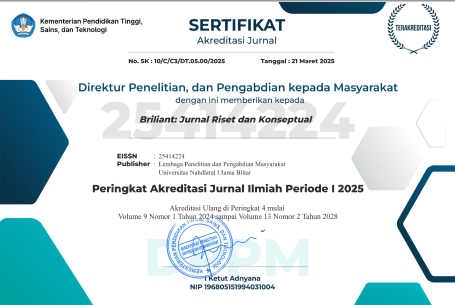
Analisis Keterampilan Asesmen Diagnostik Non-Kognitif terhadap Self-Efficacy Konselor dalam Melaksanakan Program BK Komprehensif
DOI:
https://doi.org/10.28926/briliant.v11i3.2470Keywords:
Non-Cognitive Diagnostic Assessment, Counselor, Comprehensive GC Program, Senior High School, Self-EfficacyAbstract
The implementation of the Independent Curriculum demands professionalism among counselors in conducting comprehensive Guidance and Counseling programs. However, technical barriers to the implementation of non-cognitive diagnostic assessments have been identified, which impact counselor self-efficacy. This study aims to analyze the influence of non-cognitive diagnostic assessment skills on high school counselors' self-efficacy in implementing comprehensive guidance and counseling programs. Using a quantitative correlational design, this study involved 84 counselors from public high schools in Semarang City. The research instruments included a modified School Counselor Self-Efficacy Scale (SCSE) and a non-cognitive diagnostic assessment skills scale. Data were analyzed using simple linear regression through IBM SPSS. The results showed a strong positive relationship between non-cognitive diagnostic assessment skills and self-efficacy. This finding provides an empirical contribution that strengthening non-cognitive diagnostic assessment skills is an important factor in improving counselor self-efficacy, thus providing a basis for developing professional training and developing comprehensive guidance and counseling programs that are more student-centered. Based on these findings, it is necessary to replicate the study on a wider geographical scale and with various types of schools in the future to increase the generalizability of the findings in the context of national education.
References
Afiat, Y., Fitriani, W., & Fitri, A. T. (2021). Need assessment sebagai manifestasi unjuk kerja konselor. Al-Tazkiah: Jurnal Bimbingan dan Konseling Islam, 10(1), 1–20. https://doi.org/10.20414/altazkiah.v10i1.3410
American School Counselor Association. (2005). The ASCA national model: A framework for school counseling programs. Professional School Counseling, 9(2), 165–168. https://doi.org/10.1177/2156759X0500900210
Azis, A. C. K., & Lubis, S. K. (2023). Asesmen diagnostik sebagai penilaian pembelajaran dalam Kurikulum Merdeka di sekolah dasar. Pena Anda: Jurnal Pendidikan Sekolah Dasar, 1(2), 20–29. https://doi.org/10.33830/penaanda.v1i2.6202
Bandura, A. (1986). Social foundations of thought and action: A social cognitive theory. Prentice-Hall, Inc.
Bandura, A. (2000). Self-efficacy: The foundation of agency. In A. Flammer (Ed.), Control of human behavior, mental processes, and consciousness: Essays in honor of the 60th birthday of August Flammer (p. 16). Lawrence Erlbaum Associates.
Bardhoshi, G., & Erford, B. T. (2022). Psychometric synthesis of the School Counselor Self-Efficacy Scale (SCSE). Measurement and Evaluation in Counseling and Development, 55(3), 205–218. https://doi.org/10.1080/07481756.2021.1955214
Bardhoshi, G., & Um, B. (2021). The effects of job demands and resources on school counselor burnout: Self-efficacy as a mediator. Journal of Counseling & Development, 99(3), 289–301. https://doi.org/10.1002/jcad.12374
Barnes, K. L. (2004). Applying self-efficacy theory to counselor training and supervision: A comparison of two approaches. Counselor Education and Supervision, 44(1), 56–69. https://doi.org/10.1002/j.1556-6978.2004.tb01858.x
Budiono, A. N., & Hatip, M. (2023). Asesmen pembelajaran pada Kurikulum Merdeka. Jurnal Pendidikan dan Konseling (JPDK), 5(1), 1018–1027. https://doi.org/10.31004/jpdk.v5i1.11187
Cashwell, T. H., & Dooley, K. (2001). The impact of supervision on counselor self-efficacy. The Clinical Supervisor, 20(1), 37–41. https://doi.org/10.1300/J001v20n01_04
Cinotti, D. A., & Springer, S. I. (2016). Examining the impact of non-counseling supervisors on school counselor self-efficacy. Journal of School Counseling, 14(11), 1–11. http://www.jsc.montana.edu/articles/v14n11.pdf
Fakhriyani, D. V. (2021). Self-efficacy konselor dalam melaksanakan pelayanan bimbingan dan konseling: Sebuah tinjauan literatur. Jurnal Konseling dan Pendidikan, 9(2), 145–152. https://doi.org/10.29210/158200
Hati, S. M. (2021). Efektivitas penggunaan aplikasi Quizizz dalam melakukan asesmen diagnostik non-kognitif siswa kelas 12 IPS lintas minat di SMA YPHB Kota Bogor. Arus Jurnal Pendidikan, 1(3), 70–75. https://doi.org/10.51249/ajup.v1i03.22
Hidayat, D. R., et al. (2021). Asesmen dalam bimbingan dan konseling: Konsep dan aplikasi teoretis. PT Remaja Rosdakarya.
Hidayat, D. R., Kustandi, C., & Putrawan, I. M. (2021). Analisis kebutuhan asesmen non-kognitif dalam pengembangan program bimbingan dan konseling berbasis data di sekolah. Jurnal Bimbingan dan Konseling Terapan, 5(1), 12–25.
Indah, N., & Fitria, N. (2022). Urgensi asesmen diagnostik non-kognitif dalam implementasi Kurikulum Merdeka di tingkat menengah. Jurnal Bimbingan dan Konseling Terapan, 6(2), 145–158. https://doi.org/10.30598/jbkt.v6i2.1703
Kementerian Pendidikan Nasional. (2020). Pedoman pelaksanaan kurikulum pada satuan pendidikan dalam kondisi khusus. Pemerintah Indonesia.
Kementerian Pendidikan, Kebudayaan, Riset, dan Teknologi. (2022). Panduan pembelajaran dan asesmen: Pendidikan anak usia dini, pendidikan dasar, dan menengah. Badan Standar, Kurikulum, dan Asesmen Pendidikan.
Maharani, C. A., Rosra, M., Yusmansyah, Y., & Utaminingsih, D. (2019). Analisis kesulitan guru pembimbing dalam menguasai konsep dan praksis assessment. Jurnal Inovasi Ilmu Pendidikan, 1(2), 123–136. https://doi.org/10.23960/jiip.v1i2.21316
Middleton, T., & Bardhoshi, G. (2025). The relationship between school counselor self-efficacy, empowerment, critical consciousness, and social determinants of health competency: An initial investigation. Journal of Counseling & Development, 103(1).
Mufidah, E. F., Abdillah, H., & Habibah, A. H. (2026). Portrait of counselors' self-efficacy in the implementation of individual counseling services in schools. JKPI: Jurnal Konseling Pendidikan Islam. https://edu.ojs.co.id/index.php/jpit/article/download/746/883/1868
Mullen, P. R., & Lambie, G. W. (2016). The contribution of school counselors’ self-efficacy to their programmatic service delivery. Psychology in the Schools, 53(3), 306–320. https://doi.org/10.1002/pits.21899
Phil, S. M. (2021). Pembelajaran dan asesmen kompetensi. Badan Penelitian dan Pengembangan dan Perbukuan, Kemdikbudristek.
Prasetiawan, H. (2020). Self-efficacy konselor sekolah dalam melaksanakan layanan bimbingan dan konseling di masa pandemi. Jurnal Fokus Konseling, 6(1), 22–30. https://doi.org/10.26638/jfk.830.2099
Rahman, K., & Ririen, D. (2023). Implementasi asesmen diagnostik non-kognitif dalam kebijakan sekolah. Edukatif: Jurnal Ilmu Pendidikan. https://doi.org/10.31004/edukatif.v5i5.3954
Rakhmi, M. P., Purwo, A., Utomo, Y., Adiratna, A., & Ghufron, W. (2023). Pemanfaatan Google Form dalam asesmen diagnostik di SMA Negeri 11 Semarang. Jurnal Abdi Masyarakat, 2(1), 115–126. https://doi.org/10.59024/jam.v2i1.125
Sanders, C., Welfare, L. E., & Culver, S. (2017). Career counseling in middle schools: A study of school counselor self-efficacy. The Professional Counselor, 7(3), 238–250. https://doi.org/10.15241/cs.7.3.238
Stone, C. B., & Dahir, C. A. (2010). The transformed school counselor. In Encyclopedia of cross-cultural school psychology (pp. 835–842). Springer. https://doi.org/10.1007/978-0-387-71799-9_432
Stone, C. B., & Dahir, C. A. (2011). School counselor accountability: A measure of student success (3rd ed.). Pearson.
Suhertina, S., & Meladianty, N. (2023). The influence of counselor self-efficacy on the quality of comprehensive guidance and counseling programs in senior high schools. International Journal of Counseling and Education, 8(1), 12–21. https://doi.org/10.23917/ijce.v8i1.22123
Tang, A. (2019). The impact of school counseling supervision on practicing school counselors’ self-efficacy in building a comprehensive school counseling program. Professional School Counseling, 23(1). https://doi.org/10.1177/2156759X20947723
Um, B., & Bardhoshi, G. (2024). School counselors’ burnout, hope, and self-efficacy: A sequential regression analysis. Journal of Counseling & Development, 102(3), 320–331. https://doi.org/10.1002/jcad.12513
Yusuf, A. M. (2021). Evaluasi pendidikan: Teknik asesmen dan intervensi non-kognitif dalam pendidikan. UNP Press
Zamroni, E. (2022). Efikasi diri konselor sekolah: Urgensi dan pengembangannya dalam praktik profesional. Jurnal Fokus Konseling, 8(1), 45–56
Downloads
Published
Issue
Section
License
Copyright (c) 2026 Dian Purbo Utomo, Intan Laksmita Mayastuty , Cindy Aprillia

This work is licensed under a Creative Commons Attribution-ShareAlike 4.0 International License.